Assistive technology that earns its place.
Equipment prescription is a strong interest of ours. We assess what equipment would help you live more safely and independently — wheelchairs, adjustable beds, transfer aids, hoists, mobility aids, daily-living aids — and write the clinical reports that secure the funding for them. (For changes to the home itself, see Home Modifications.)
What we assess.
Assistive technology covers a wide range. We work most often across:
- Daily-living equipment — shower stools, raised toilet seats, kitchen aids, dressing aids, reaching tools.
- Mobility aids — walking sticks, frames, wheeled walkers, manual wheelchairs, mobility scooters.
- Home modifications — grab rails, ramps, level-access showers, doorway widening, lever taps.
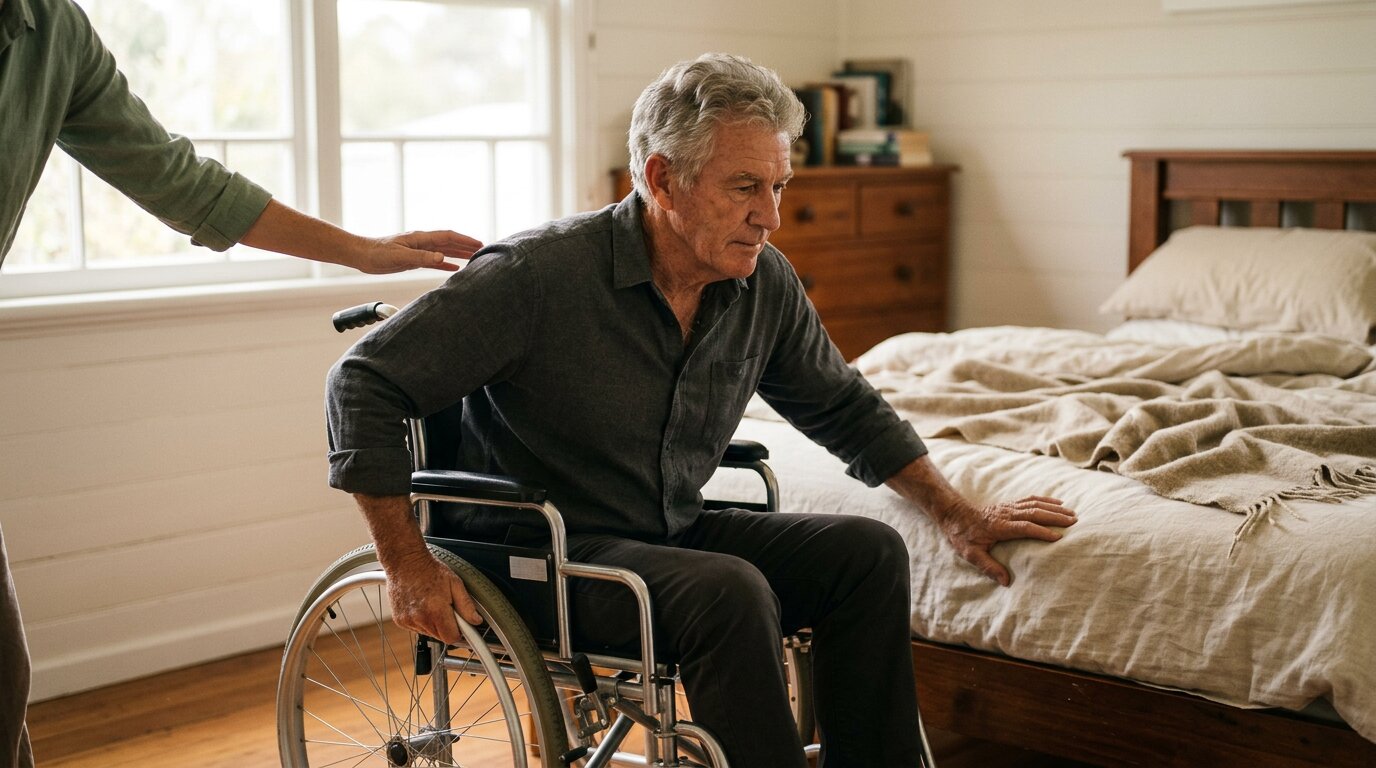
- Bedroom and transfer equipment — adjustable beds, mattresses, transfer boards, hoists.
- Cognitive and sensory aids — pill organisers, calendars, weighted products, low-vision aids.
For higher-cost (Level 3) assistive technology — such as power wheelchairs or complex pressure care — we may refer to or work alongside a specialist OT with that competency. We will tell you transparently what is and is not within our scope before we start.
How the process works.
Initial conversation
What is the problem you are trying to solve? What have you already tried? What is your home like?
Assessment
For most equipment, an in-home or telehealth session. For home modifications, an in-person visit so we can measure and observe.
Trial where possible
Many AT items can be trialled before commitment. We arrange this where it makes sense.
Recommendation and report
The clinical report justifies the recommendation in the format the NDIA expects. We send it to you, your SC, and the supplier as needed.
Quotes and ordering
You or your support coordinator handle the quotes. We help if helpful.
Common questions about AT.
What is the difference between Level 1, 2, 3, and 4 assistive technology?
The NDIS classifies AT by cost and complexity. Level 1 is low-cost, low-risk (under $1,500). Level 2 is mid-cost, common items (around $1,500-$15,000). Level 3 and 4 are higher-cost, more complex items requiring specialist competency. Most adult AT we assess sits in Levels 1 and 2.
Do I need an OT report for low-cost AT?
For most items under $1,500, an OT report is not required if the item is in the NDIS low-cost AT list and you have it written into your plan. For items above that, or anything on the high-risk list, an OT assessment is required.
Will you visit my home?
For home modifications and any assessment where the home environment is the issue — yes, in-person across the Northern Rivers. For straightforward equipment, telehealth often works just as well and is faster.
How long does it take?
From referral to written report, usually four weeks for straightforward AT, and six to eight weeks for home modifications where we need contractor input.